Parker Gun Collectors Association Forums  

Go Back   Parker Gun Collectors Association Forums Parker Forums General Parker Discussions

Notices

Reply
 
Thread Tools Display Modes
Unread 03-09-2012, 02:04 PM   #1
Member
ed good
On Vacation

Member Info
 
Join Date: Feb 2010
Posts: 787
Thanks: 205
Thanked 203 Times in 124 Posts

Default

mike: wonder why that is? ed
ed good is offline   Reply With Quote
Unread 03-09-2012, 03:40 PM   #2
Member
Bill Murphy
PGCA Lifetime
Member Since
Second Grade

Member Info
 
Join Date: Jun 2009
Posts: 16,917
Thanks: 7,003
Thanked 10,368 Times in 5,465 Posts

Default

Mike,
Bill Murphy is offline   Reply With Quote
color case
Unread 03-09-2012, 06:58 PM   #3
Member
Parker Bachelder (Brad's Profile)
PGCA Member

Member Info
 
Join Date: Jun 2009
Posts: 296
Thanks: 177
Thanked 1,928 Times in 203 Posts

Default color case

It is imposible to quickly explain all of the variables that effect color case hardening. Contrary to conjecture and rumor the process is controlable and predictable.

two constants in the process are: type of metal, machineing reliefs.
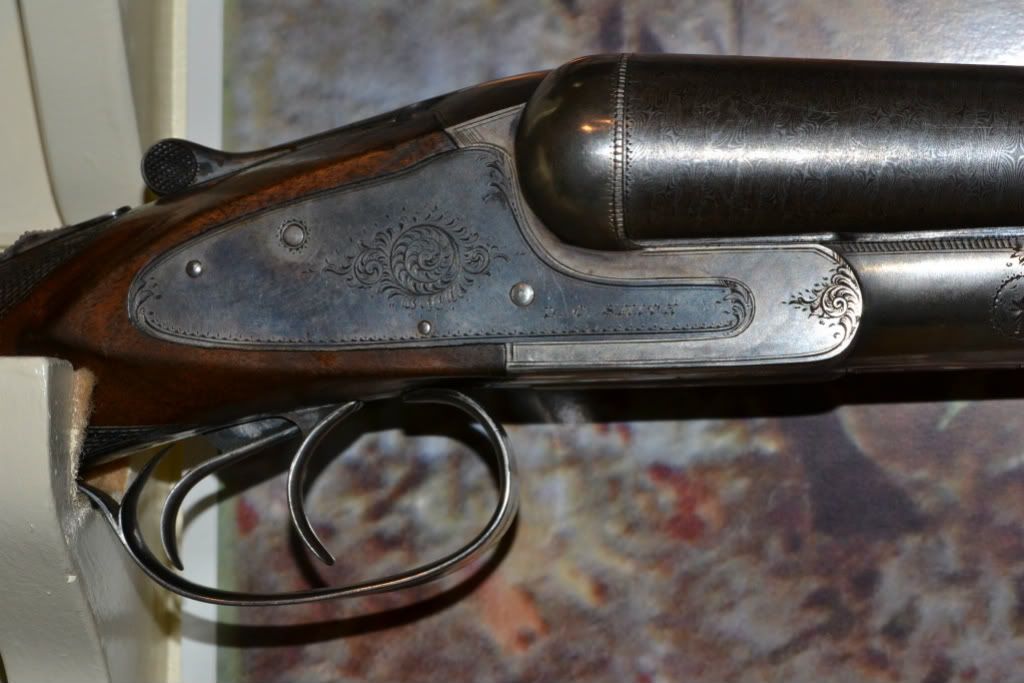
The type of metal cast, forged, or rolled dteel, absorb carbon at different rates. Rolled steel, due to molecular density absorbs more carbon than cast steel. Sideplates and triggerplates are usually rolled steel accounting for deeper, longer lasting colors. Recievers cast or forged, absorb less carbon or color affecting durability.
Machineing translates to repeatable patterns in like parts. In the heat up phase thick areas remain cooler than thin areas. at quench thick areas cool slower that thin areas. Two prime examples of this in Parkers are the center band of color on triggerplates at the point of machineing for the cocking slide. The centers of the water table flats at the hammer spring pockets.
Parker forearm irons form a distinctive pattern at the "T", we refer to this pattern as "antlers". This is created by drawback or outside cooling at quench.
Pin holes, screw holes and edges drawback or turn straw or grey due to rapid cooling.
Color ranges, contrast, machineing patterns and patina, are all controlled with process variations in packing materials, tempature,surface preperation and exposure to oxygen. A careful educated study of original specimens is the most important factor in creating a process formula. Every manufacturer used the same basic process. The secret ingredents were not magical or chemical. The variations were in process crontrols and specific steel types.
We utilize over 20 different process formulas to yiels specific colors and patterns by brand and era.

Brad
Brad Bachelder is offline   Reply With Quote
Visit Brad Bachelder's homepage!
Unread 03-10-2012, 12:53 AM   #4
Member
Pa SxS
Research Chairman
PGCA Lifetime
Member
 
Chuck Bishop's Avatar

Member Info
 
Join Date: Nov 2008
Posts: 3,010
Thanks: 1,289
Thanked 5,455 Times in 1,528 Posts

Default

[QUOTE=Brad Bachelder;64478] Two prime examples of this in Parkers are the center band of color on triggerplates at the point of machineing for the cocking slide. The centers of the water table flats at the hammer spring pockets.

Brad, thanks for answering the questions I had wondered about in the above quote. When I try and determine original Parker colors, those two things are what I try to analyze. Sometimes the center band of color may or may not be real noticeable but the water table flats usually are.

Perhaps you can also comment on an observation concerning recased colors is that usually the recased colors have too much straw around the edges of the frame where darker Parker colors go right to the edge. Parkers had very little straw colors in my opinion.
Chuck Bishop is offline   Reply With Quote
The Following User Says Thank You to Chuck Bishop For Your Post:
Unread 03-10-2012, 01:01 AM   #5
Member
Pa SxS
Research Chairman
PGCA Lifetime
Member
 
Chuck Bishop's Avatar

Member Info
 
Join Date: Nov 2008
Posts: 3,010
Thanks: 1,289
Thanked 5,455 Times in 1,528 Posts

Default

Bruce,

What's the maufacture date on that B grade? My DH, made in 1903, has almost all of it's original case colors and from a distance you'd swear the receiver was blued until you got up close, then the dark blues and reds started to become apparent.
Chuck Bishop is offline   Reply With Quote
Unread 03-10-2012, 04:59 AM   #6
Member
edgarspencer
PGCA Member
 
edgarspencer's Avatar

Member Info
 
Join Date: Sep 2011
Posts: 6,732
Thanks: 3,425
Thanked 13,615 Times in 3,587 Posts

Default

Just to be clear, My comments were not intended to represent myself as a gunsmith, experienced or otherwise. A gunsmith is truly a craftsperson. Any temperature ranges I quoted are from experience from production methods used in the heat treatment of steels, in a cast state. Ultimately, the desired hardness and ductility was the determining factor is arriving at them. The colors were a byproduct of the surface hardening to prevent wear of the newly engraved surfaces. Machining and engraving is done while the part is in a softer, annealed state, and the final combination of the parts hardness, strength and ductility aren't achieved until all heating/ cooling cycles are done. The craftsman are those that take the basic information, and modify it to the desired end. The temperature ranges I quoted are, in fact those used by Colt, as explained to me by their personnel, when arriving at an alloy for their boxes. It's important to note that they were the first normalizing cycles the parts were exposed to, and not necessarily those a gun being restored would see. As the old adage says "The proof of the pudding is in the eating". Anyone who is able to replicate the colors imparted as the original manufacturer offered up, in my book, is the guy who gets my vote, and Brad Batcheldor's work, in my estimation, represents the best i have seen out there.
As many of us have seen in the last few weeks, The upcoming James Julia auction has a half dozen Colt Calvary models coming up, whose colors are as close to original, if they aren't actually original. That I believe they are actual Colt restorations, it makes no difference, as their work today is no different than it was 120 years ago. Long before they had a department called 'The Custom Shop', my dad had Colt restore a martial piece, and it looks today just like those shown in the Julia auction, no more, no less.
edgarspencer is offline   Reply With Quote
The Following 4 Users Say Thank You to edgarspencer For Your Post:
Unread 03-10-2012, 10:55 AM   #7
Member
Parker Bachelder (Brad's Profile)
PGCA Member

Member Info
 
Join Date: Jun 2009
Posts: 296
Thanks: 177
Thanked 1,928 Times in 203 Posts

Default

Chuck,
Excellent observation, Parkers are overall very dark. The absense of straw, green and yellow are due to packing material, run temp and quench. Parkers colors are subtle and washed unlike the vivid multi-hue colors of late production Smiths.
In fully engraved Parkers with 90% original colors it very hard to see any color at all.
Brad
Brad Bachelder is offline   Reply With Quote
The Following 2 Users Say Thank You to Brad Bachelder For Your Post:
Visit Brad Bachelder's homepage!
Reply

Thread Tools
Display Modes

Posting Rules
You may not post new threads
You may not post replies
You may not post attachments
You may not edit your posts

BB code is On
Smilies are On
[IMG] code is On
HTML code is Off

Forum Jump


All times are GMT -4. The time now is 05:27 AM.

Powered by vBulletin® Version 3.8.4
Copyright ©2000 - 2025, Jelsoft Enterprises Ltd.
Copyright © 1998 - 2025, Parkerguns.org
Copyright © 2004 Design par Megatekno
- 2008 style update 3.7 avec l'autorisation de son auteur par Stradfred.