
|
 |
 |
||||||||||||||||||||||||||||||||||||||||||||||||||||||||||||||
| |||||||||||||||||||||||||||||||||||||||||||||||||||||||||||||||
 |
 |
 04-18-2017, 02:18 PM
|
#3 | ||||||
|

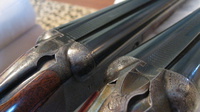
I have a Parker with a second set of barrels from Purdey that are M/F. These are nice for late season Grouse when the leaves are down and the birds flush a little bit farther away, they are also nice when Pheasant hunting and I use them on the sporting clays course.
__________________
There is no hunting like the hunting of man, and those who have hunted armed men long enough and liked it, never care for anything else thereafter...Earnest Hemingway |
||||||

|

|
||||||
 |
 |
 |
| The Following User Says Thank You to Rich Anderson For Your Post: |
|
|
|
04-18-2017, 03:15 PM
|
#4 | ||||||
|
Mr. Jay:
First, there isn't much difference in velocity for moderate upland field loads in most any gauge. Thus, the tight chokes are there for another reason in the 20 and 28. That reason is pattern density. Because the smaller gauges carry less shot for their bore size (the ridiculous 3" 20-bore excepted) tighter chokes help to keep more pellets within the 30" circle at most game ranges. This reduces wounded birds. If you miss, chances are you'll miss clean. If you hit, it may well be an effective and humane kill. (pardon the obvious oxymoron) That's not to say an IC choke is ineffective. If you shoot quickly and are spot on, they work just fine. But you must be a bit more skilled. |
||||||
|
|
|
||||||
|
|
|
| The Following 3 Users Say Thank You to John Campbell For Your Post: |
|
|
|
04-18-2017, 04:00 PM
|
#5 | ||||||
|
For your purposes Tom, as with mine, I'd stick with the Q1 & Q2 or the IC/Mod chokes. I've taken plenty of grouse and woodcock with my IC/Mod and Kathy's Q1 & Q2 28 gauge Repros and I wouldn't really have a use for Mod/Full in places where I hunt.
.
__________________
"I'm a Setter man. Not because I think they're better than the other breeds, but because I'm a romantic - stuck on tradition - and to me, a Setter just "belongs" in the grouse picture." George King, "That's Ruff", 2010 - a timeless classic. |
||||||
|
|
|
||||||
|
|
|
| The Following 2 Users Say Thank You to Dean Romig For Your Post: |
|
|
|
04-18-2017, 04:52 PM
|
#6 | ||||||
|
I have a 20 gauge Sterlingworth choked Mod/Full and it is great for wood ducks. A similarly choked 28 gauge might do the same thing. It also might be good for clays.
|
||||||
|
|
|
||||||
|
|
|
| The Following User Says Thank You to Mills Morrison For Your Post: |
|
|
|
04-18-2017, 05:40 PM
|
#7 | ||||||
|
I have been addicted to Parker Reproductions for many years and have owned way too many single barrel, two barrel and even a three barrel set guns in all gauges.
I have never once fired any of the 28" Mod/Full barrels! Bob Jurewicz |
||||||
|
|
|
||||||
|
|
|
| The Following User Says Thank You to Bob Jurewicz For Your Post: |
|
|
|
04-18-2017, 05:58 PM
|
#8 | ||||||
|
I have shot 28 gauge guns for almost 50 years, SxSs. O/Us, and repeaters. Handloaded for them for years as well as went through about every variation of factory ammo there is. One thing I can tell you for certain is that the 28 gauge LIKES choke! For woodcock and railbirds, nothing like cylinder or Q1/2 or skeet in tight covers. But for doves, snipe and the occasional long shot on quail, nothing beats a SxS or O/U with mod & full in a 28 ga. Also, if that's your only combination, try RST's spreader loads - they're great for opening up tighter guns in heavy cover. Their #10 shot spreader in 28 ga. is a real killer.
|
||||||
|
|
|
||||||
|
|
|
| The Following 6 Users Say Thank You to Kevin McCormack For Your Post: |
|
|
|
04-19-2017, 10:23 AM
|
#9 | |||||||
|
Quote:
Down side is, it takes more skill to wield a smaller pattern. That's where the term; "Expert's Gun" comes from, when applied to small bore shotguns. |
|||||||
|
|
|
|||||||
|
|
|
|
|
|
04-19-2017, 04:40 PM
|
#10 | ||||||
|
I hope I don't get drummed out of the PGCA for admitting this, but I have a John Dickson and Sons 28 gauge boxlock with 26 inch barrels. It is choked .004 and .031. Although I now only use this gun for only grouse (ruffed, not the prairie variety) and woodcock, it was once my gun of choice for everything, and I took more pheasants (from here in North Missouri/Southern Iowa) with this gun than any other I have used. The choking on this gun is perfect for grouse for me, from Minnesota to Virginia. Some years ago I ordered a two barrel set 28 gauge AYA 453. I specified one set Skeet I/Skeet II and the other Cylinder/Full. The Cylinder/Full barrels are unused. The other barrels have taken lots of game, mostly wild quail here in the Midwest and grouse in Minnesota and the Appalachians. I shoot over pointing dogs and use standard 3/4 loads, mostly 7 1/2s (but 8s earlier in the grouse season). Unless your are doing some dramatically different kinds of shooting, I don't know if you'll really use two sets of barrels. That's my 37 years of experience, but I'll bet someone chimes in with something contradictory. In the end, get what you can afford and makes you happy. Life is very, very short.
|
||||||
|
|
|
||||||
|
|
|
| The Following 4 Users Say Thank You to Garry L Gordon For Your Post: |
 |
| Tags |
| 28 gauge, parker, reproduction |
| Thread Tools | |
| Display Modes | |
|
|








 Linear Mode
