|
 |
|
 |
| Notices |
Welcome to the new PGCA Forum! As well, since it
is new - please read the following:
This is a new forum - so you must REGISTER to this Forum before posting;
If you are not a PGCA Member, we do not allow posts selling, offering or brokering firearms and/or parts; and
You MUST REGISTER your REAL FIRST and LAST NAME as your login name.
To register:
Click here..................
If you are registered to the forum and keep getting logged
out: Please
Click Here...
Welcome & enjoy!
To read the Posts, Messages & Threads in the PGCA Forum, you must be REGISTERED and LOGGED INTO your account!
To Register, as a New User please see the Registration Link Above. If you are registered, but not Logged In, please Log in with your account Username and Password found on this page to the top right.
Hi Unregistered,
On July 29th, this site will be moving..! No, really - it's "moving" to another physical location - including servers, gateways, routers - everything - including my coffee cup...
So, from the date of July 29th through July 30 or 31 (shooting for these dates, but - as always, I'm at the mercy of my ISP who has to install the lines to the new location - and we actually get them running ;) ). But - this site, cloud servers and main web will be OFF LINE.
Now, please save these dates!! Please - don't be "that guy" who emails me on the 30th to tell me you "can't open the Parker Website". I'll already know it is offline - and also know that you are "that guy"...
I'll take this notice up and down over the next week or so - and leave it up during the final few days before shutting it off on the 29th..
John D.
|
 |
|
|
color case |
|
 03-09-2012, 05:58 PM
|
#21
|
 Member
|
|
|
|
Member Info
|
Join Date: Jun 2009
Posts: 296
Thanks: 177
Thanked 1,928 Times in 203 Posts
|
|
 color case
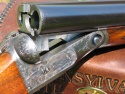
It is imposible to quickly explain all of the variables that effect color case hardening. Contrary to conjecture and rumor the process is controlable and predictable.
two constants in the process are: type of metal, machineing reliefs.
The type of metal cast, forged, or rolled dteel, absorb carbon at different rates. Rolled steel, due to molecular density absorbs more carbon than cast steel. Sideplates and triggerplates are usually rolled steel accounting for deeper, longer lasting colors. Recievers cast or forged, absorb less carbon or color affecting durability.
Machineing translates to repeatable patterns in like parts. In the heat up phase thick areas remain cooler than thin areas. at quench thick areas cool slower that thin areas. Two prime examples of this in Parkers are the center band of color on triggerplates at the point of machineing for the cocking slide. The centers of the water table flats at the hammer spring pockets.
Parker forearm irons form a distinctive pattern at the "T", we refer to this pattern as "antlers". This is created by drawback or outside cooling at quench.
Pin holes, screw holes and edges drawback or turn straw or grey due to rapid cooling.
Color ranges, contrast, machineing patterns and patina, are all controlled with process variations in packing materials, tempature,surface preperation and exposure to oxygen. A careful educated study of original specimens is the most important factor in creating a process formula. Every manufacturer used the same basic process. The secret ingredents were not magical or chemical. The variations were in process crontrols and specific steel types.
We utilize over 20 different process formulas to yiels specific colors and patterns by brand and era.
Brad
|

|

|
|
The Following 23 Users Say Thank You to Brad Bachelder For Your Post:
|
Dave Fuller, Dave Suponski, David Weber, E Robert Fabian, ed good, edgarspencer, Eric Eis, Frank Cronin, Gary Carmichael Sr, Joe Wood, John Havard, Louis Caissie, Mark Landskov, Mark Ouellette, Mike McKinney, Mike Shepherd, Paul Ehlers, Ralph English, Ray Pond, Richard Flanders, Russ Jackson, Stephen Hodges, tom leshinsky |
|
|
|
|
|
|
03-09-2012, 05:58 PM
|
#22
|
|
Member
|
|
|
|
Member Info
|
Join Date: Sep 2011
Posts: 6,944
Thanks: 3,587
Thanked 14,443 Times in 3,761 Posts
|
|
In a roundabout way, you're getting towards the answer. The thinner section parts receive a cycle time sufficient to reach the center of the mass, while heavier sectioned materials likely receiving the same duration 'soak', so not likely to reach the mass center. This is why thinner parts, whose shapes are more uniform, have a more uniformly colored surface, unlike receivers, whose colors vary directly in relation to the section thickness.
A part whose shape was achieved by forging, has a tighter grain structure than a part whose shape was formed by machining a cold rolled material, but, and a big but, the two parts have a substantially similar grain structure when the cool down from the 'soak' temperature begins, which is when the part absorbs any carbon-rich propertiess from the packing material.
You keep mentioning shotguns whose frames were made by machining a cold rolled bar, as opposed to a forging, and for the life of me, I can't think of any American made shotgun whose frame was not machined from a forged part. There were lots of well known forging companies, such as Billings & Spencer, who supplied near-net-shape parts to manufacturers who didn't have their own drop forging facility. The very logical reason is simply that machining time is much more expensive than forging to near net shape, then final machining less material.
|
|
|
|
|
The Following 5 Users Say Thank You to edgarspencer For Your Post:
|
|
|






 Linear Mode
